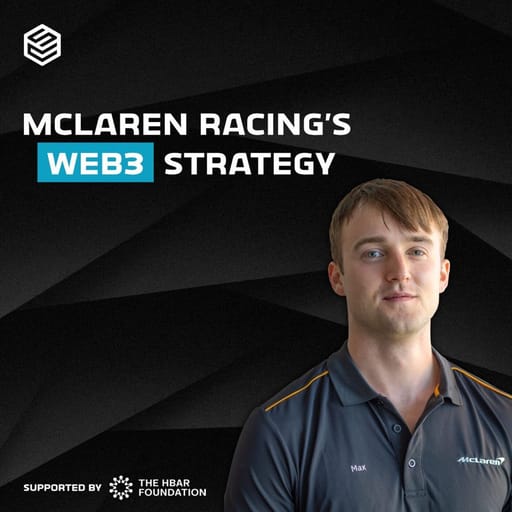
Transcript 0:00 Formula 1, for example, the teams are always trying to innovate, right? Everyone knows about the on-track innovation, the cars always developing. That's not the only place where we compete. 0:10 We compete off the track for fans. 0:12 [gentle music] Welcome back to the Sporting Crypto Podcast, where we talk to leaders in sport and Web3 about their journey in this crazy world. 0:32 This is episode six, and I'm really happy to be joined by Max Wolff, sat beside me, who is the senior manager, Web3 and digital licensing at McLaren Racing. Max, how are you? Did I get your title right? Yeah. Perfect. 0:46 Not easy to do, so well done to you, Pat. Thanks so much for having me. Um, great to be here. Inaugural season of the podcast, so yeah, very excited. 0:54 Why don't you tell us a little bit more about what your energy is focused on right now? What is the role that you've got at McLaren Racing? So McLaren Racing, my role is pretty much divided into two parts. 1:05 Uh, there's the Web3 side and the digital licensing side. In Web3, this can cover anything blockchain/Web3 related we do. 1:13 Historically, this has been mostly NFTs, but there's a lot of exciting scope for that to expand, different types of tokens, different types of programs that we wanna get into. 1:22 Digital licensing can be things more around virtual spaces, metaverse, avatars, whatever sort of ancillary new tech might be coming up around Web3, in addition to, like, more standard, just digital content licensing stuff. 1:36 And then also, I have another person on my team, I'm not gonna dox him here, but, uh, on our Discord, he's known as Blue, and he's the other half of the Web3 team. 1:45 He does an amazing job, you know, supporting the program, but also managing the Web3 community on Discord. And then for you, crypto, Web3, like, where did the interest stem from? Yeah. 1:54 So crypto and Web3, I think for me, there were a couple things that really piqued my interest more than just cryptocurrencies, more than, like, the money aspect of things. 2:06 I think that there's sort of three attributes that give value to a physical good, right? You have authenticity, scarcity, and definitive proof of ownership. 2:17 Blockchain really enabled, for the first time, you to be able to bring those three attributes to a digital asset in a decentralized way. 2:26 Maybe you could always have a scarce digital asset in a game, but it was always gonna be owned by EA Games or whatever. 2:33 So for the first time in, in blockchain, you were able to have a, a digital asset that, um, no one could take away from you, and that connected with the idea that, you know, we're spending more and more time in the digital world. 2:47 Just like as in the physical world, you and I might collect things that sort of reflect our life. Like, if we, um, travel, you know, we collect fridge magnets or souvenirs from our journeys. 2:57 So we should do that in the digital world too, and I was really fascinated by that idea. Like, you know, how much time do you spend online? What do you have to show for it? 3:05 Like, you collect a browser full of cookies, and [laughs] it's like, who wants that, right? 3:09 So it kinda made sense to me that we should be accumulating a digital inventory of scarce, valuable assets that we have proof that we own. 3:18 And so the idea of that is what really got me into crypto more so than just, like, crypto tokens and, and yeah, cryptocurrencies. 3:27 I always think it's very good to try and step back and really dumb down the value proposition here. Yeah. 3:36 And for the most part, when we talk about NFT specifically, right, we're talking about simply being able to own things online. 3:43 And if we think that the consumer web has only been mainstream and consumer-facing, I guess, for the last, like, 30, 40 years. Before that, you know, it was being used by army intelligence and so on and so forth. 3:54 But the consumer web since the late '80s, early '90s type of thing, we've never been able to own anything online. And 4:02 the arrival and inception of blockchain as of, I don't know, probably 27 to 16, 17, when specific token standards started coming out, I mean, you could own fungible tokens. 4:12 But you can now, as you said, own something, like, scarce or authentic, and I, I love the way that you've broken that down. 4:20 It's really, really interesting, and I love when complicated things are abstracted into more simplified means for people to really get what the value proposition is. Yeah. 4:31 When- whenever I explain it to people, I always use the adva- uh, the example of the Mona Lisa, right? Like, I can get you a, a copy of the Mona Lisa today, but you don't want that. 4:41 You want the original, so something that can't be copied. You can prove who owns the Mona Lisa, right? It, it's there in the Louvre. 4:47 It's easy to tell if, if it's faked, and like, digital items were always like that before. 4:52 And so now that you can have these, like, everyone can own a digital, you know, their own Mona Lisa, it brings up the potential for some really cool applications. 5:00 Sometimes there are conversations wh- when you tell people that, and they're like, "Well, yeah, I kinda get that," but you can still see it, right? It's save the image. Yeah. 5:08 In the same way that we can take a picture of the Mona Lisa. Exactly. And, uh, I think what people sometimes forget is inherently, NFTs are a, a freemium model, right? 5:17 Like, I could collect a, a Silverstone collectible- Yeah... uh, from the race this weekend. Absolutely. And I own that. 5:26 Someone could use that collectible as their profile picture or whatever, but there's only one owner, and I think that people are only just starting to cotton on how big a unlock that is for the web. 5:38 Absolutely, and we're trying to teach people that too. 5:41 So like, yes, of course, even go into our own Discord on a release day, people will copy and paste or like, you know, um, upload the image of the collectible to the channel. 5:53 But that doesn't mean that that person who uploaded it to the channel gets the holder benefits, which is extra entries into that weekend's giveaway on the server. 6:02 So, like, we're using little mechanisms like that to teach people the difference of-Actually owning it versus just, you know, having it saved on your computer, for example. 6:11 Let's delve deeper into your story up until now. So talk me through everything up until your current role at McLaren. Right. Yeah. [laughs] So it's, it's been a journey. 6:21 If we wind all the way back, like I've been a motorsport fan, a petrol head since I was nine years old. I remember it very clearly. I watched the first episode of Top Gear I've ever seen. 6:34 It was the episode where, uh, the guys chopped the top off a Renault Espace and, like, turned it into a convertible people carrier. I think Jeremy tested the Koenigsegg CCX to... Richard tests a Nissan Micra. 6:47 James May tests a Honda Civic. I remember it so clearly, and since then I was just been cars, cars, cars my whole life. Um, and then, you know, getting into crypto, that really happened more during the pandemic. 7:00 So right out of university, I, um, along with a friend of mine, we started an athletic apparel brand, which doesn't have anything to do with crypto, but rather just like entrepreneurship. 7:10 You know, we were hungry to get out there and try stuff. After that, I was employee number one at, um, one of my former professor's healthcare technology platforms. 7:20 That business got killed by COVID, so I took that time to sort of pause, went and got my master's degree, and then during that time, I really started to fall down, like the NFT crypto rabbit hole. 7:30 Got super interested in the idea of digital assets, digital items, and then, yeah, coming out of my master's, I just had this thought, like, if I can put these two things together, cars and motorsport plus NFTs and crypto, and yeah, that led me to this role at McLaren. 7:46 Can you recall that first interaction you had with NFTs? What was the light bulb moment for you when you were looking at this space a little bit more seriously? Honestly, I think it was... I think it was music NFTs. 8:01 So I remember looking at like ASAP Rocky's drops, um, and this was in, what was it? Twenty twenty or twenty twenty-one, like the height of the bubble. There was no utility attached to it. 8:13 There was nothing particularly special about the drop. It's a three-D scan of ASAP Rocky in a T-pose. I still have it. Yeah, it was just cool. 8:20 And that light bulb moment of seeing like an artist putting out something in the digital world that his fans could collect and own, that like represented a link to him, I just thought that was super cool. 8:32 I started to dive in a bit more, like my hobbies are, uh, growing plants. Like, I love to, to garden, and I was able to buy like unique plant NFTs to decorate a virtual space. 8:44 So I don't know, I just thought it was a really cool and exciting sort of innovation. Really interesting. And joining McLaren, you joined at a time when they'd already started their Web3 journey to some extent. 8:57 Yeah, that's correct. Uh, I think they launched their NFT program on a Friday, and then I joined on the Monday. So yeah, good timing. 9:06 You coming into that, was the job spec for you to do a lot of the Web3 stuff, or is that something that you grew into? No, that was the spec. 9:13 So I was hired to lead the Web3 project, um, as well as do a bit of the digital licensing. At the time it was just me, so Blue hadn't joined yet. 9:21 Um, so I was m- trying to manage the Discord as well, and, uh, yeah, it was a lot of learning, um, a lot of creating processes where there weren't any, a lot of internal education and a lot of, a lot of heavy lifting in the start, honestly. 9:37 Why don't you give us a chronological timeline of activations that McLaren have had on the Web3 front? Yeah. So walking you through our NFT program, so we started with an MCL35M drop. 9:51 So the MCL35M was our twenty twenty-one Formula One car, and the first drop we did was around the US Grand Prix of that year in Austin, and we broke the Formula One car up into twenty-two separate parts. 10:07 Each part was an NFT. Each part, uh, was like a three-D model, um, m-modeled on real McLaren CAD data, so they were super intricate, super high definition, really cool. 10:19 Um, the parts were all released in different quantities, and the first thirty-five people to collect all the parts were able to get a full car, you know, like the complete NFT of the full car. 10:30 That's how the program started off. Those, um, thirty-five holders still represent our like Genesis OG holder group. We have a special group for them in the Discord. 10:39 And since then, honestly, we just experimented with a bunch of crazy different ideas. Uh, we've done IRL activations. 10:47 So like last year at Silverstone, um, if you came to our merch tent, there was a QR code you could scan, and each day there was a different NFT for sale. You could only buy it if you were there at Silverstone. 10:59 There was a driver helmet, suit, and boots, and each day there was a different prize associated, uh, with that NFT. So one day there was a hot lap up for grabs, another was a garage tour. 11:12 The final day there was a, um, tour of the MTC. Uh, my favorite project we worked on last year was called Kiwi's Caper. 11:19 [chuckles] So that was a special release that we did for the Singapore and Japan, uh, GPs, which are back to back. 11:26 So just like how the team travels from Singapore to Japan between the races, we made a, a comic book following the adventures of our mascot, the Speedy Kiwi, from Singapore to Japan. 11:39 Each page of the comic book was an NFT, and if you collected all of the different pages, then we sent you a physical version of the comic book. 11:47 Um, so we've tried a bunch of stuff like trying to cross the physical and, and digital barrier. The last like sort of phygital release we did, I hate that word. 11:56 I don't know if you have a better term for me, but- I d- I really don't. I'm sorry. Yeah. No one does. Uh, if anyone in the audience has one, maybe they can put it in the comments or something. Yeah. 12:03 [laughs] What can I say other than phygital? But yeah, the last phygital release we did, um, was supported by a company called CollectID, and, um, we basically used their tech to put-NFC tags on these posters. 12:17 And, uh, when a fan would scan the tag with their phone, we got, uh, an animated version of the poster to open up, and they could claim it as an NFT. 12:27 The NFT is like proof that they own that limited edition number poster in the physical world, but they could also scan the NFC tag and it would bring up, um, exclusive videos, like messages from Zak, from our esports drivers, from the poster designers. 12:41 So yeah, we've done a lot to try and play with digital and physical. Lots of different driver rewards, uh, or like utilities, you know, calls with drivers, um, signed merch, that sort of stuff. 12:53 And then our most recent program done in collaboration with our amazing partners, Tezos, um, you know, they're our official blockchain partner, it's the twenty-three of twenty-three program. 13:02 The twenty-three of twenty-three program represents twenty-three different collectibles for the twenty-three different races that we have in the Formula One calendar this year. 13:12 They're all free to claim, and so each weekend, from the Friday to the Monday of a race weekend, fans can go to our site, collectibles.mclaren.com. They can claim their collectible for free. 13:23 There's a bit of a gamification element around it, so if you collect them all, you're in with a chance to win a race experience for next year. 13:29 We have sub-collections, like collect all the classic races and you can win a signed cap, small sub-collections like that. 13:36 And yeah, it's, it's been really well received and, uh, we're halfway through it and it's going great. 13:41 Give me some numbers around how well this activation's done, because I think this is the thing you've done a lot of experimenting, but this is the one that's gone crazy. Yeah. 13:49 This is the one that's really blown up for us. So headline stats are, we've done eleven releases and we have about two million claims in total. 13:59 The program has resulted in about four hundred thousand wallets being opened on the Tezos, uh, protocol, and we have added solidly in the six figures, um, people signing up to our McLaren Plus loyalty program through this, uh, twenty-three of twenty-three project, so really big numbers. 14:17 What race has had the smallest amount of claims? What's the one that's had the, the biggest? Uh, that's a great question. 14:22 I think biggest was Miami or Azerbaijan around the start of the project, and, uh, that was like race number three and four. 14:31 The smallest was the first one because the word was still just getting out there, but it's been pretty consistent. Each race, uh, we have between a hundred and two hundred thousand people claiming each token. 14:41 That must be an amazing validation for you to go internally and say like, "Hey, look, you don't have to monetize directly. This thing's working here." 14:49 Honestly, it really surpassed my expectations how many people we were a-able to add to the loyalty program through this. 14:55 Um, we almost hit the business's entire yearly target just through this, uh, program itself, so yeah, it's been very strong for us. Well, I'm, I'm sure you got a few kudos internally. Yeah. People have been pleased. 15:08 [laughs] People have been pleased. That's brilliant. I have a question for you, right? All this experimenting, some of it goes well, some of it goes not as well. Mm. 15:16 What I've seen from a lot of big brands is they realize usually this, in retrospect, this is like a product we've launched basically. Yeah. What is the overarching thing that holds this all together? 15:25 And now with Nike we've seen them do CryptoKicks and do launches with RTFKT and stuff and blah, blah, blah, and then they go into creating a platform called.Swoosh where everything aggregates into. 15:36 Do you ever find yourself internally being like, "Everything we're doing is, is great but quite disparate, and we're gonna eventually bring it together 15:45 into something bigger," or is it totally fine having some really awesome activations that then f- are a, are a, a great flywheel or feedback loop into a loyalty program or like curated drops by your community, stuff like that? 16:00 So, I mean, it's kind of a boring answer, but the truth is it's a bit of both. So right now I think the central point that everything pulls into is our Discord community. 16:10 That's our focus for this year, is building a community of people who are interested in Web3, introducing some of our fans, our Formula One fans who are new to Web3, but you know, introducing them to the idea that like, hey, it's not scary to collect tokens. 16:25 You know, digital collectibles can be fun. There's utilities behind it. 16:29 Um, that's why, you know, the decision was made along with Tezos to go like with a free drop this year, just to sort of get people comfortable with dipping their toes into the water. 16:39 Not everyone who takes a token will join the Discord. You know, there's a s- a relatively small conversion rate from people who claim tokens to people who join the Discord. I think our ultimate vision, 16:51 what I'd love to see is, as a fan, you join our Web3 program and it almost is a sort of McLaren loyalty program, and interacting with our brand across many different touchpoints all contributes to a sort of loyalty experience where, you know, maybe you follow us on social media, that's tracked and maybe you earn a token for it in your wallet. 17:16 You, uh, purchase something from our web store, so you get a token from that, and then these tokens are-- can be used to unlock additional experiences in a virtual space, maybe unlock discounts in our shop, something like that. 17:29 But then of course, every Web3 activation we do doesn't have to always lead back into earning points in the loyalty program. 17:38 I think what you're gonna start to see, not just from us but from a lot of major sports brands, is Web3 activations involving their partners. 17:47 So maybe we have a partner that has an authentic story that wants to bring their audience and, you know, combine it with our Web3 fans and offer them an exclusive experience, a product or something. 18:01 I could see there's definitely scope for some, like partner-led activations. 18:05 And I think if you've already got that kind of, I guess, on-chain network that you folks do with the millions of claims and however many unique claimers there are-That's a, a incredibly compelling for a partner 'cause you can say like, "Look, we've had too many people claim. 18:20 There's 500,000 unique people that have claimed these things across 13 races. We can activate 500,000 people through their wallets on chain." Exactly. And like, that's so exciting, right? 18:31 Like, you have these people who are excited about digital collectibles. It's a huge group that you've created. 18:38 They want to engage, and now all of a sudden we can combine that with our amazing network of partners who have all these incredible products, services, experiences, or whatever, and like, it's only natural to connect them. 18:50 It's like an everyone wins scenario. Can you give me an idea of what conversations were like internally at McLaren Racing before the big successful 23 of 23 launch and after? 19:06 The internal view of Web3 is one of like excitement, but maybe everyone is still just a little unsure of what this is gonna turn into. And again, I don't think that's unique to us. 19:18 I think that's the industry in general, right? Like, we're still in the, in the early years of Web3. We don't know where this is gonna, where this is gonna lead. Before the 23 of 23, I think we were all just... 19:30 We had a, a year where we focused mo- mainly on paid drops, and the people that did engage with it were really pleased. But with a paid NFT drop or token drop from McLaren, you know, who are you really targeting there? 19:45 It's the intersection in the Venn diagram between the Formula One fan and the Web3 fan. And man, you can really like, you can hit a home run with that intersection, but it's a small intersection, right? 19:57 So by going more towards a free model or at least a, you know, nominal fee claim model, you expand the, the number of people you're targeting. 20:07 Suddenly you're targeting all Formula One and all McLaren fans because there's no financial risk to participating, and suddenly you're targeting all Web3 fans as well. 20:17 Maybe they're new to Formula One, not McLaren fans- Mm-hmm... but there's a cool token from like a sports brand that, you know, has fast cars and, and is exciting. 20:26 And so you incentivize just a huge number of people to get involved, and I think there's been a lot of excitement around that internally. And you say internally, what's the fan response been like? 20:38 You know, the people in your Discord and the community you've curated, are they 20:43 satisfied with just this, uh, 23 of 23, um, or are they excited to be at the ground floor and see like where this could go as a, as a gamified fan engagement platform? Yeah. I th- I think it's both. 20:54 So first of all, the response has been really positive. 20:58 We have some seriously hardcore fans in our Discord, and I remember last year, you know, like they'll support everything we do, but they wouldn't engage with the Web3 side of things. 21:08 And this year for the first time, we are seeing them come over, start to have fun with the tokens, engage in the digital collectibles program. So I'm really proud of the response. The fans have been super supportive. 21:21 Really important in that is not just the gamification aspect, but also that like the artwork just looks cool. Yeah, you've gotta have that, that attractiveness, that, that good product behind it. 21:32 In terms of the fans being satisfied or not with the 23 of 23 program, I think definitely they are because if you look at Formula One fans, they're used to following a team throughout the Formula One season. 21:45 They're used to watching 22, 23 races a year. Now all of a sudden they have something to show for it, right? 21:52 Now they're doing what they did anyways, but they have this beautiful collection of artworks that help them remember those moments along the season. 22:01 They're amassing that digital inventory that I was talking about earlier that's so interesting. 22:05 And one of the cool things we do is we hide little Easter eggs within each poster, and if you go on our Discord at one minute past 10:00 AM UK time every Friday when there's a drop, it's full of messages of all of our fans like working together and racing each other to try and tease out the meanings behind these Easter eggs. 22:26 And so, yeah, like you, you get like really genuine, really fun interactions, and I think fans enjoy that, and being able to look back and see the history of, of it in their wallets is, is really cool. 22:36 In my mind, like there's loads of ways this could go as well, right? This is the first season of it. Yeah. 22:41 Partnership activations where you say, "Look, if you've collected 23, one of our partners," I'm gonna name a random one. Yeah. Pick, pick one on, uh- Pick one [laughs] There we go. OKX. There we go. 22:52 OKX say we're, you know, giving away like an full suite of OKX branded apparel, or we're doing our own digital collectible with a, with a driver, and anyone who's got 23 gets this $100 digital collectible for free. 23:09 Off the top of my head, that's one really interesting area. Like, I think the other is, you know, when Dot Swoosh launched by Nike, they launched with simply giving away Nike IDs, like literally online accounts. 23:21 This is your access pass to having an account. You mentioned like a, a loyalty program, and that's kinda funneled into something off chain. 23:28 But again, like the idea of having a baseline of 400, 500,000 people that could be interested in like a Web3 native application on your phone or like a dashboard, again, creating that inventory, there, there's so many routes this, this could take and it must excite you a lot. 23:44 You're at a really interesting point in time now. Yeah, absolutely. I mean, not to speak in like businessisms, but it's pure blue ocean. There, there's so much potential to work with. 23:53 And so in that, what do you have to double down on? What do you have to concentrate on? Being authentic. That's really my message, and like fans know when something comes from a place that's not authentic. 24:07 They know if you're going for a cash grab. 24:09 They know if what you're doing is just a pure marketing exercise that doesn't have any intention of delivering them real utility or value or, you know, like furthering their, their love for the sport. 24:20 So I think-We've done a lot of great work so far, you know, with Tezos and our partners to, to create this group, and now it's about continuing to treat them right, give them things that they care about, and, you know, keep that great relationship that we have with this group of fans. 24:37 Because it's very easy as a big brand to not have the humility, right? Like, we are McLaren, right? 24:42 We're sponsored by all these people, and we can just drop something and it will work, or we can just do something in this space and it will work. 24:48 But I like the kind of attitude that you've got, which is, "We're at the precipice, we're at the bottom of the mountain, and whilst we've got a huge current of momentum with us, we still have to go up that mountain." 24:59 Yeah, of course. And, you know, it's like everyone's got that friend that only knocks on their door when they want something, right? You don't wanna be that person for the fans. 25:08 You don't wanna just engage them when you're trying to shill something to them. 25:12 So we wanna work with this group in a way that provides them value and also, like, is a big opportunity for us as a, as a brand to engage some of our partners. So yeah, it's very exciting. 25:25 From the stats you mentioned and from a lot of people I'm speaking to in the industry, there's been a, a big shift from commercialization- Yeah... within these types of activations 25:36 to more of a, like, an engagement-led approach. Yeah. Can you give me an idea of the conversations that led you folks to going down the latter of those routes and why that's happened? Yeah. So it's, it's a good question. 25:51 I think we're very lucky to have a very supportive partner, um, in Tezos, and it always goes back to, like, what's your metric of success, right? 25:59 So if you're just purely using revenue as your metric of success, well, last year we were doing more paid drops and maybe we were only engaging, you know, several thousand people, but we were making revenue from the token sales. 26:13 So you would have to say that it was more successful. But having people around you in the business and partners who are comfortable with using a metric of success other than revenue, that's the key, right? So... 26:25 'Cause as soon as you look at numbers of engagement, last year was a few thousand, this is a few million, so it's orders of magnitude better. 26:32 Uh, so yeah, it's just, like, having the confidence and having the environment to be able to s- shift your focus and use sort of a different yardstick as your measure for success. I really like that. 26:43 Someone has to pick up the check eventually, but, like, if you have partners and internal champions that are happy to give you the runway to experiment and make those small bets until one of them is a, is a home run as it seems the 23 of '23 has been, I think that's a really important shift. 26:58 And, you know, from a sports perspective, we've got some rights we wanna license, we wanna make money from them, and if it's kind of okay, doesn't matter. 27:07 Like, as long as we get the check signed, then there's a minimum guarantee. 27:10 I think that model is, is definitely dying unless you are, like, a major, major, major rights holder that will always have demand for whatever you sell as a licensee. This attitude is definitely shifting, isn't it? 27:22 Yeah, absolutely. Formula 1, for example, the teams are always trying to innovate, right? Everyone knows about the on-track innovation, the cars always developing. That's not the only place where we compete. 27:34 We compete off the track for fans. 27:36 We compete to have the biggest fan bases that are most attractive because it makes us, um, more attractive proposition to partners and also, you know, we, we compete in ways to engage our fan bases better so that our fans are more invested in the brand and, and love us more. 27:54 So yeah, that sort of model of just, uh, we're gonna license out our content to someone, there's gonna be an MG and, and that's it, it's not always compatible with trying to be at the forefront of, like, fan engagement. 28:08 And so I think that's where our focus is really right now. That's part one wrapped up. 28:13 And before we move on to part two, uh, where we look at the future a little bit and explore where McLaren might go and where sports generally might go when it comes to Web3, I need to remind you that this podcast is supported by the HBAR Foundation, who are an ecosystem accelerator of Hedera, the most used sustainable enterprise-grade DLT for the decentralized economy. 28:35 Together with industry-leading use cases and globally renowned partners, the foundation is scaling Web3 consumer engagement across the metaverse, gaming, DeFi, regenerative finance, and beyond. 28:47 [upbeat music] Welcome back to part two, and now we're gonna talk a little bit about the future and things more broadly, things about McLaren, but also things in sport, racing, F1. 29:06 Why has Web3 and racing been such a great crossover for the most part when it comes to partnerships? Yeah. Um, I think it's just because Formula 1 is all about innovation, right, and so is Web3. 29:20 So there are so many opportunities f- to have Web3 apply to Formula 1, you know, whether or not it's merchandising, ticketing, uh, brand activations, you know, doing stuff for fans. 29:32 So you always have that spirit to, like, innovate in new ways, develop new things on track, so that also extends then to, um, Formula 1 teams trying to innovate to better serve their fans, bring more value, better experiences, more opportunities to the fans, and I think Web3 is just viewed as another potential tool to do this. 29:54 So it only makes sense that, like, you know, the forefront of technical innovation off track would also be attractive to Formula 1 teams. 30:03 Obviously, when it comes to sponsorship, ticketing, the amount of events there are, there's a lot of inventory there, right? And de facto, that means there's a wide range of things that you can do. Can or can't? Can. 30:17 Yeah, can. So- But maybe can't as well. I don't know. Uh, yeah, it's, it's a bit of both, honestly. 30:21 So-You're right, there's a lot of inventory out there, but that doesn't mean that, like, there's inventory that hasn't been previously allocated, right? Everything that's out there is being used and sold. 30:32 There's a little bit of probably internal work to do, um, across the sport, and it's probably not just F1, but all sports towards, like, reallocating assets- Mm... to support, uh, Web3 programs. 30:46 And sometimes stuff gets unused, right? Yeah. 30:48 Slips through the cracks because there's so much, and a partner not falls short, but might not be able to attend the race or a partner drops out of a activation last minute, all these kinda things, and there's, there's a lot there as well. 31:01 Yeah. 31:01 Web3 can be a great way to capture assets that for whatever reason can't be utilized, um, you know, from partner contracts, maybe at the last minute, as you said, something, someone's not able to attend or something. 31:12 So you can use, um, Web3 to maybe monetize that content or give it back to fans when it otherwise would've previously just had to go to waste. Where do you see the future for McLaren Racing and Web3? Yeah. 31:27 So I mean, to quote Seb Vettel, "I have balls, but they're not crystal." [laughs] So I mean, it's, it's hard to tell. 31:35 I think going back to my previous answers, like, I really see th-the future in a Web3 program that's sort of like a holistic loyalty program that captures all of a fan's, um, interactions with the team, so rewarding them for following us on social media, for purchasing our products from the store, for engaging in a virtual space that we set up, and then being able to take whatever tokens or whatever Web3 assets they earn from that and using it to unlock additional experiences. 32:10 And the cool thing for me is that, like, you know, it, it can be within our ecosystem too, but also it could be in another ecosystem as well. And like, that's pretty exciting as well. 32:20 Maybe there's a really cool game that loves McLaren, and even though we don't have a formal relationship, they just decide that, "Hey, anyone who has a bunch of these, like, McLaren loyalty tokens, we're gonna give them some cool benefits." 32:33 So yeah, that idea really excites me as well. A lot of the people we've had that we've interviewed have obviously been from, I'd say, like, bigger sports organizations as well, or have worked at, like, bigger brands. 32:45 But I think what's unique to, let's say, McLaren, you're in a place right now where F1 has exploded over the last four years, and you know, can, you can attribute that to better broadcast coverage or Drive to Survive or new demographics paying attention. 33:01 What's it like working in a world that's exploding, F1's exploding, and you've got Web3 going crazy? It's great. [laughs] It's really fun. I wake up every day, and I'm excited to go to work. 33:14 There's so much opportunity out there, and there's so much scope to just do cool stuff. 33:21 So, like, one of the things that I'm most excited about is, um, doing a project in virtual spaces, so being able to give fans the opportunity to attend our headquarters or McLaren garage, for example, but do it in a bit more of a whimsical way. 33:38 You know, I think one of the tropes of virtual spaces is, like, people just try and replicate the physical world one-to-one, but come on, you can be more fun. 33:46 Like- Especially when the tech's so early and it's not as, it's not the same. Yeah, it's not the same. Like, if, if I'm gonna make a racetrack in the virtual world, put a loop-de-loop. Uh, put it going around a volcano. 33:59 Why not? Like, it's just, it's just fun, and I mean, there's definitely, like, a market for people who want one-to-one recreations, but we have sim racing for that. Mm. We have the F1 23 game for that. 34:10 So yeah, I think it's just, there's a lot of opportunities to work in this sport, this industry. As you said, Web3 is on fire. Formula One is on fire. 34:21 There's lots of scope to just do cool stuff that's fun, that engages the fans, and, uh, yeah, virtual spaces is like one of those avenues that I think is really a cool way to do it. 34:31 We're talking about the, the hypergrowth of F1. Does that make it easier or harder for you in the sense that there's so much attention suddenly coming into the sport as a whole and then the teams individually? 34:43 Is it a fight for you internally to get attention to the Web3 programs that you want? Or on the other side of the coin, is it a case of like, "Well, we've got someone talented internally, 34:54 and we're doing all this new stuff because our brands are exploding in a good way. We can pitch Web3 at every single level of everything we're doing"? Yeah. It's, it's more the latter, honestly. It's a good thing. 35:06 Like, the explosion of Formula One, uh, obviously, you know, a lot of that has come from Drive to Survive and the increased popularity in the North American markets. 35:15 That just allows us to try and be more innovative, and it gives us more opportunities to express our brand in new ways that maybe we haven't tried before. 35:27 I think where the difficulty can come in, and like sometimes we see this on social media, is we want to do new things and engage a new audience, but we can't alienate our older fans who have been with us for a long time. 35:41 We still need to be the McLaren that they know and love and that they've grown up with, while also, like, being fresh and exciting and, you know, trying to attract this new generation of Formula One fans. 35:52 So there's always a balance to doing that. You know, it, it can be tricky at times, but it's just a challenge to solve for and, and it's fun. 36:00 Let's switch gears a little bit and talk about things more broadly again outside of F1. What are you most excited about in this space? Yeah. For me, there's a couple things that, that I really get excited about. 36:14 One, I've said it before in this interview, and I'm gonna say it again, um, virtual spaces. 36:19 I love the idea of, you know, I, I don't wanna call it metaverse, but just like-Interactive 3D environment that you can access, you know, from your web browser on your phone without having to, like, install a desktop client. 36:32 I think there's a lot of potential applications there, giving people token-gated experiences in that environment. Basically, like, a more interactive, more, like, engaging version of our Discord server. Mm-hmm. 36:44 I'm really excited about that. I spoke before as well about all of the releases we've done that are sort of like hybrid physical and digital. 36:52 I still think there's a lot of room to improve the way that physical goods are linked to their digital twins, and so that's something that I'm really excited to see get solved over the coming years. 37:06 I don't have the answers on how that should best be done. Maybe it's about smart devices. 37:10 Um, there's a lot of people who are smarter than me that are working on that problem, so I'll be anxiously looking to see what they come up with. 37:17 The virtual spaces thing is interesting because obviously the, the metaverse has caught so much flak, and I think rightfully so for, for most parts, right? 37:25 Like what Facebook have leaned into is probably not what a lot of people are gonna spend time in, and then boom, you have like the Apple Vision Pro. 37:34 I, I don't know if you saw the MLB Improbable connect to the MLB stadium for the All-Star Game in a virtual space. 37:42 Again, that looks like a lot more higher fidelity than what we've seen with like the Central Land and so on and so forth. Yuga are obviously building a, a game with Improbable as well. 37:53 That kind of thing is coming, and I don't think the first, second, or third iteration, in the same sense the iPhone wasn't the mainstreamiest smartphone until, like, the three or fourth iteration of it. 38:07 Why are you excited about it now rather than thinking like, "We'll get there when we get there," in terms of the tech? I guess it's all about my goals, what I imagine people doing in these spaces. 38:21 I'm not trying to get fans to spend, you know, eight hours a day working in the virtual space. I'm not trying to get people to replace their ha- their, like, physical world habits. 38:32 For me, as a racing fan, I would love to go into a McLaren experience where I can explore the MTC, where I can, like, maybe watch a YouTube premiere of some new content from McLaren, where I can walk along the boulevard, see all the historic cars. 38:49 Maybe I can have a virtual scavenger hunt, and maybe I can play a little racing mini game and, and earn rewards with fans. 38:56 And I think those types of experiences are much closer to being around the corner, and I think those types of experiences are already really valuable to us as a brand. 39:06 So I think for us, I see, like, the destination of virtual spaces and, quote-unquote, "metaverse" being a lot closer than necessarily like in the working world. 39:17 Conversely to the excitement, what do you think is being over-hyped at the moment and seeing a lot of attention that you think, "Mm, I'm not too sure about that"? So this one, it's a bit tough. 39:31 I think what you're gonna see in the future, and this is just my view, it's a bit of a transition away from continuous ongoing utility towards more discrete utility, uh, in token projects. 39:46 So I think this is not to say that fans and holders should get accustomed to getting less utility for their tokens. That's not it at all. 39:56 But I just think that recently there's been a big push towards, like, people expecting that you buy a token, and you're entitled to benefits as long as you hold that token and they're recurring forever. 40:07 Frankly, I don't think it's sustainable for a lot of projects and for brands as well from a financial perspective. 40:14 You get the revenue to support the project from the initial token sale, but then to keep having to attach utilities to it, I mean, yeah, it's just not sustainable. There's no business fit. 40:25 There's, there's no business fit and, you know, we do Web3 to engage fans. We do it to provide utility, but it can't be a cost center. Like Web3 has to be financially sustainable, and that's not just true for McLaren. 40:38 That's true for, like, the industry as a whole. If this technology is to survive, brands and companies have to be able to, you know, run it not at a loss. 40:49 And so I think you're gonna see a shift towards token projects being dropped with much more, like, discrete utility packages that have ends. 40:58 And again, that's not to say that people are gonna be getting less utility because these can be amazing experiences, amazing physical items and stuff. 41:06 I just think you're gonna see finish dates, expiration dates attached to the utility propositions of tokens. I guess y- you're paying attention a lot to the tech as well. 41:16 Where do you think we need to see the biggest improvement for some sort of mainstreaming? You talked about the discrete utility, but broadly speaking, 41:25 this is still a niche, and how does it become available and utilized more? Okay. 41:31 So everyone gives the same answer to this question, and that's in order to mainstream, the tech needs to get smoother so that people and users and fans, whatever, don't even realize they're interacting with a blockchain product, right? 41:44 Like they need to not even realize that they're claiming a token, an NFT or something that's underpinned by blockchain. That's fine. That's great. 41:53 I agree, but I'm gonna try and be a bit more interesting and give you a different answer. Um, so for me, I think one thing that we need to see in order to achieve mainstreaming is better communication. 42:06 This is a huge challenge that I definitely face, and I think a lot of other projects do too. Like how do you communicate with your holders? 42:16 You basically rely on your holders either being in your Discord server or proactively going to check their holder dashboard, like coming to a website or webpage that you own. 42:27 Like there's no way to send them a push notification really.Maybe you have an email list of people. Mm-hmm. Like CRM. 42:36 But I don't think relying on email is, like, the solution that we should all just be accepting in the Web3 world. So what I really wanna see is some sort of, like, in-wallet communication. 42:49 I've heard of, like, Salsa and a couple other sort of, like, wallet-to-wallet communication. 42:53 I think Coinbase just launched something recently as well around, um, wallet communications, but I think that might be specifically to Coinbase wallets. Yeah, exactly. 43:01 So what I wanna see is, is something that can cross wallets. 43:05 So, like, as the administrator for a program, I can send a push notification, a push message that appears in-wallet, regardless of the wallet, whether or not it's Kukai, Trust Wallet, Temple, you know, whatever it might be, so that I can tell my holders about utility. 43:22 I can tell them about upcoming promotions. I can send them discounts or, like, engage them, um, in other marketing campaigns. 43:30 So yeah, I s- I think, like, improvements in administrator-to-holder communications is something I'd love to see. Yeah, that's really interesting. 43:38 I think, um, the amazingness of having, like, this on-chain network and then siloed communication means can plug into it. 43:47 But until you have something that completely flows just within that network of on-chain, uh, audience, it is gonna be more difficult. 43:56 It is gonna be off-chain, and it's gonna be really exciting to see what kind of products get built there. Yeah. Couldn't agree more. And I think on that note, we will wrap things up. 44:04 Uh, thank you so much all for watching and listening and staying with us up until this point. Max, thank you very much for coming on. Where can people find out more about you? 44:13 Please feel free to connect with me on LinkedIn, Max Wolfe, McLaren Racing. Uh, alternatively, join our Discord, discord.gg/mclaren. I'm on there. Blue is on there. 44:25 I'm not gonna give away the mystery and tell you what my name is on Discord, but, uh, if you head over to the off-topic channel, mention you watched this interview, some say the first person to do it might win something cool from McLaren. 44:37 Who knows? Who knows? Wow, that is, um-- If you've listened to or watched this long, then, uh, get yourself in there and get something exclusive. I didn't tell him to do that, by the way. That's just completely organic. 44:46 Yeah, Pet, you can't win that, by the way. [laughs] I can't win that. You can find me, uh, @PetBerisha on Twitter, at P-E-T B-E-R-I-S-H-A, or on LinkedIn, where I'm spending a lot more time, on the same name. 44:58 And if you haven't already, please subscribe to this podcast, but also to our newsletter, the Sport in Crypto newsletter that goes out every Monday and keeps you up to date on all things sports and Web3. 45:09 And just remember that none of what we have said during this show is financial or business advice, and this content is for informational purposes only. 45:16 Web3 is underpinned by crypto, and crypto is volatile, meaning you can lose money if you are buying these assets personally or as a business. 45:23 Where we are recording right now in the UK, the majority of crypto asset companies are unregulated. Please leave us a review or leave a comment down below if you want to give us some feedback. 45:32 Thanks very much for watching or listening, and we'll have more content for you next time. [outro music]